
Introduction
A blood test is meant to answer questions. Funny enough, it often creates a dozen new ones.
Your dad sends you a lab report with a message that simply says, “Can you see if everything looks okay?” Your mom notices one or two values highlighted in red and quietly starts worrying. Before the doctor has had a chance to explain anything, everyone in the family has an opinion. Someone has already searched Google. Someone else is reading an old health forum. The WhatsApp group suddenly turns into a medical discussion.
You’d be surprised how common this is.
The report isn’t the problem. It’s doing exactly what it’s supposed to do. The catch is that it’s written for clinicians who spend years learning how different biomarkers relate to one another. Patients receive that same document without the medical context, so even perfectly routine results can feel difficult to make sense of.
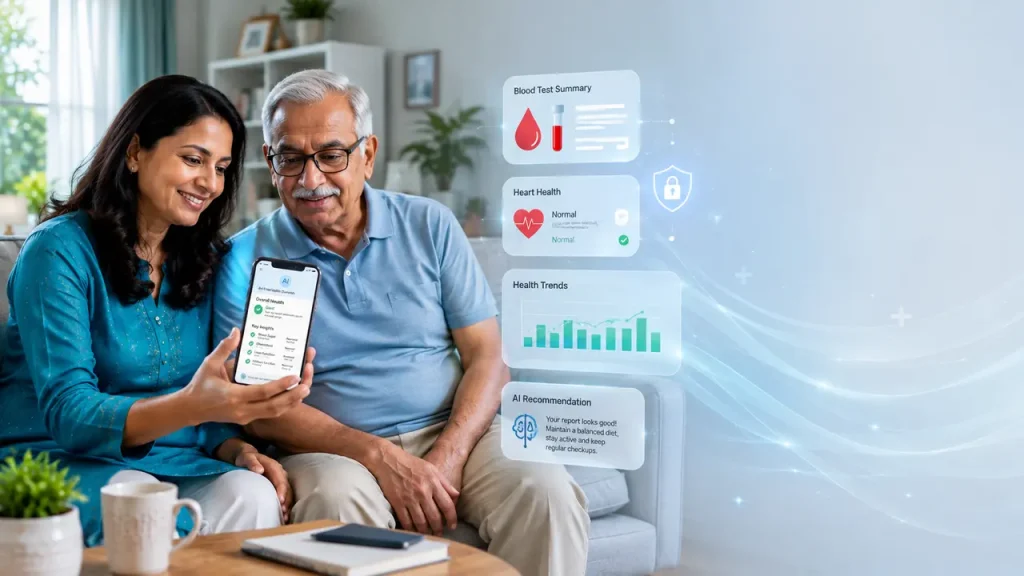
That’s where the best AI health report summarizer app becomes genuinely useful. Rather than expecting people to understand clinical language, it explains the report in words most of us actually use every day. The important findings are easier to spot, medical jargon becomes easier to follow, and families walk into the doctor’s appointment with a better understanding of what they’re looking at.
Clear explanations do more than save time. They help people make better decisions.
The World Health Organization (2024) continues to identify health literacy as an important factor in patient outcomes, noting that many people struggle to understand medical information well enough to act on it. When a report leaves you guessing instead of informing you, it’s easy to see why so many families feel overwhelmed before they’ve even spoken to their doctor.
Medical Reports Don't Need Simpler Numbers. They Need Simpler Language.
Look at almost any blood report.
You’ll find abbreviations, reference ranges, percentages, medical codes, and dozens of numbers lined up in neat columns.
Doctors know how to interpret that information because they’ve spent years doing exactly that. Patients haven’t.
Now imagine your parents opening the report after a routine health check.
One value is a little higher than normal.
That’s enough.
“Should I be worried?”
“Do I need more tests?”
“Is this something serious?”
Questions arrive almost instantly.
The report gives you measurements. What it rarely gives you is context. It doesn’t explain why one value matters, whether another result changes its meaning, or if the findings are connected in any way.
That’s where many families get stuck.
An AI report summarizer doesn’t replace the doctor sitting across the table. It simply explains the report before that conversation happens. Instead of forcing people to decode technical terminology, it rewrites complex findings into plain, understandable language. Suddenly, the report feels less intimidating.
Think of it as translating a document rather than interpreting a diagnosis.
There’s a difference.
Blood Tests Are Only One Piece of the Puzzle
Most people think of blood reports first when they hear about AI in healthcare.
That’s understandable.
Bloodwork is one of the most common medical documents people receive.
The reality, though, is that patients deal with many different reports throughout their healthcare journey, and most of them come with the same challenge. They’re full of technical language that isn’t particularly friendly to someone without a medical background.
TinyBit helps users understand a wide range of reports, including:
- Complete Blood Count (CBC)
- Lipid Profile
- Liver Function Test (LFT)
- Kidney Function Test (KFT)
- Diabetes reports, including HbA1c
- Thyroid function reports
- Vitamin deficiency reports
- Preventive health check-ups
- Diagnostic summaries
- Routine laboratory investigations
Whether it’s your yearly preventive screening or follow-up bloodwork after treatment, the goal stays exactly the same. Help people understand what they’re reading without making them search every unfamiliar word.
Another practical benefit often gets overlooked.
Medical records have a habit of ending up everywhere. One report is sitting in an email. Another is saved in Downloads. A prescription is folded inside a drawer. Six months later, finding the right document becomes a task in itself.
TinyBit keeps those reports together inside a secure Health Vault, making it easier to review previous results, compare reports from different dates, and keep your health information organised in one place.
That aligns with the direction healthcare is already moving. The Government of India’s Ayushman Bharat Digital Mission (2024) continues encouraging digital health records so patients can access and manage their medical information more efficiently.
Why Searching Every Medical Term on Google Often Makes Things Worse
Almost everyone has done this.
You open your blood report.
One unfamiliar term catches your attention.
You search it.
Then another.
And another.
“High creatinine.”
“Borderline cholesterol.”
“Low hemoglobin.”
“Elevated SGPT.”
Twenty minutes later, you’ve opened articles from hospitals, health blogs, discussion forums, and random websites you’ve never heard of.
The problem isn’t that the information is wrong.
The problem is that none of it is about your report.
Google answers one question at a time. Medical reports don’t work that way.
A cholesterol reading doesn’t exist on its own. Doctors look at it alongside blood sugar, blood pressure, age, medications, family history, and several other clinical indicators before deciding what it actually means.
Context changes everything.
Searching each marker separately strips that context away. That’s why people often end up feeling more anxious after reading ten websites than they did when they first opened the report.
A good medical report reader approaches the document differently. Instead of treating every value as an isolated number, it reads the report as a complete picture. It explains how different findings fit together, helping users understand the overall story rather than a collection of disconnected medical terms.
That’s a much more useful place to start before speaking with a doctor.
Less Panic. Faster Understanding. Better Decisions.
The biggest advantage isn’t that AI saves a few minutes.
It’s what those minutes save you from.
Anyone who’s helped a parent understand a medical report knows the feeling. One unfamiliar term can quickly turn into an evening of searching, guessing, and worrying. Before long, the conversation shifts from “Let’s wait for the doctor” to “What if it’s something serious?”
Most families aren’t looking for medical advice at that point.
They’re looking for reassurance.
They want to understand the report well enough to know what it says, what it doesn’t say, and what questions they should ask next.
That’s where AI becomes genuinely useful.
Instead of leaving people to interpret complex medical language on their own, it presents the information in a way that’s easier to follow. The report starts making sense, and the uncertainty begins to fade.
According to the World Health Organization (2024), improving health literacy helps people participate more actively in healthcare decisions and communicate more effectively with healthcare professionals.
That matters more than many people realise.
When patients understand the basics before walking into the consultation room, the discussion changes. They spend less time asking what each medical term means and more time talking about treatment options, lifestyle changes, or the next steps recommended by their doctor.
It’s a small shift.
But it makes every appointment more productive.
Families caring for elderly parents often notice this difference the most. Instead of everyone trying to interpret the report differently, everyone starts with the same understanding. That alone removes a surprising amount of stress.
No technology can replace experience or clinical judgment.
It doesn’t have to.
Sometimes, making medical information easier to understand is enough to change the entire experience.
Making Medical Reports Easier to Understand with TinyBit
Medical reports should help people feel informed.
Too often, they do the opposite.
TinyBit was created to bridge that gap by making complex health information easier for everyday users to understand. Whether someone uploads routine bloodwork, a preventive health check-up, or a diagnostic summary, the platform converts technical medical language into explanations that are clear, readable, and easier to discuss with a healthcare professional.
Understanding a report is only part of the experience.
Keeping everything organised matters too.
Instead of searching through old emails, phone downloads, or stacks of paper reports before every doctor’s visit, users can store blood reports, prescriptions, and other medical documents securely inside TinyBit’s Health Vault. Previous records stay easy to find, making it simpler to review changes and keep track of health over time.
Many people search online hoping to find an AI app that explains lab reports in simple language. Others type questions like, “Can you summarize this bloodwork report?” because they’re simply trying to understand what the report is telling them before they speak with their doctor.
Those are everyday situations.
TinyBit was built with exactly those moments in mind.
The aim isn’t to replace doctors or encourage self-diagnosis. It’s to help people walk into appointments feeling informed instead of overwhelmed.
One report.
One clear explanation.
Less confusion.
Better conversations with healthcare professionals.
And if you’re looking for the best AI health report summarizer app, choose one that helps you understand your health, not just read it. That’s where TinyBit makes a real difference.
Frequently Asked Questions
Can AI explain a blood test report in simple language?
Yes. That’s exactly what it’s designed to do.
Instead of expecting you to understand medical abbreviations and technical terminology, AI breaks the report down into plain language. It explains what the important findings mean and highlights the points worth discussing with your doctor. It isn’t there to diagnose a condition or replace medical advice. Its purpose is to make the report easier to understand before your consultation.
What is the best AI health report summarizer app?
The answer depends on what you expect from it.
Some tools only explain individual medical terms. Others help you understand the report as a whole while also keeping your health records organised. A good solution should simplify medical language, protect your health data, and make it easier to prepare for conversations with your healthcare provider.
TinyBit combines AI-powered report explanations with a secure Health Vault, giving users one place to understand and manage their medical reports.
Can TinyBit explain different types of medical reports?
Yes.
TinyBit can help users understand a wide range of medical reports, including:
- Complete Blood Count (CBC)
- Lipid Profile
- Liver Function Test (LFT)
- Kidney Function Test (KFT)
- Diabetes and HbA1c reports
- Thyroid function reports
- Vitamin deficiency reports
- Preventive health check-up reports
- Diagnostic summaries
- Routine laboratory investigations
The objective is simple: help people understand what the report says without having to decode medical jargon on their own.
Is an AI medical report reader a replacement for a doctor?
No.
Think of an AI-powered medical report reader as a guide, not a doctor.
Its role is to explain what’s written in the report using language that’s easier to understand and help you prepare for your appointment. Diagnosing a condition, recommending treatment, or prescribing medication remains the responsibility of a qualified healthcare professional.
Is there a medical report reader app free to use?
Some platforms offer a medical report reader app free with basic features, while others include additional capabilities through paid plans.
When comparing options, don’t focus only on price. Look for an app that explains reports clearly, supports different report types, stores medical records securely, and makes the information genuinely easier to understand.
Why use an AI medical report summarizer instead of searching Google?
Searching Google usually means looking up one medical term after another.
Medical reports don’t work like that.
Doctors interpret several values together before drawing conclusions, and that’s exactly what makes isolated searches confusing. A medical report summarizer app reads the report as one complete document, helping you understand how different findings relate to each other instead of presenting disconnected bits of information.
Is TinyBit useful for helping elderly parents understand their reports?
Very much so.
Many people use TinyBit because they’re helping a parent make sense of blood tests, health checkups, or diagnostic reports. By converting technical language into plain English, the platform makes family conversations easier and helps everyone arrive at the doctor’s appointment with a clearer understanding of the report.
Does TinyBit keep medical records secure?
Yes.
Health records have a habit of ending up everywhere, an email attachment here, a downloaded PDF there, and a paper prescription tucked into a drawer.
TinyBit’s secure Health Vault keeps those records together in one place, so looking back at older reports, comparing results, or finding an important document doesn’t become another task on your to-do list.
Can AI replace a doctor when interpreting lab reports?
Not at all.
AI can make a report easier to read, but it can’t examine you, understand your full medical history, or make treatment decisions. It works best as a tool that helps you understand the report before you speak with your doctor, not as a replacement for professional medical care.
Who can benefit from using an AI report summarizer?
Anyone who has ever looked at a medical report and felt unsure about what it meant.
It’s especially helpful for:
- Adults managing their own health records
- Families helping parents understand medical reports
- Caregivers looking after elderly relatives
- People living with long-term health conditions
- Anyone preparing for a doctor’s appointment and wanting a clearer understanding of their test results beforehand
Understanding your report shouldn’t require a medical degree. Sometimes, all you need is a clearer explanation before you have the conversation that really matters.


