
Introduction
It is 4 p.m. on a Wednesday. You cannot say what you ate for lunch. You remember the dal was good and the rice was more than you planned. You also had two biscuits with chai, or maybe three.
The blur is normal. Most of us eat on autopilot, and a food log simply shows you what autopilot did.
The best calorie counter app is the one you will still open in month three. Look for fast food logging, a clear list of calories and nutrients, useful progress views, and solid privacy. Accuracy matters, but ease matters more, because steady logging beats perfect numbers that you stop entering after a week.
Why people start using a calorie counter app
Most people begin with a goal. Some want to lose a few kilos. Some want to build muscle. Others just want to know why they feel sleepy every afternoon. A calorie counter app helps with all three, because it turns “I eat normally” into something you can actually look at.
The need is real in India. According to the ICMR-INDIAB study, published in The Lancet Diabetes & Endocrinology in 2023, 28.6% of Indian adults live with generalised obesity and 15.3% have prediabetes. Knowing what goes on your plate is a fair first step for many families. Anyone with a health condition should still plan changes with a doctor.
Four things usually change first.
You see what you eat in a day, not what you think you eat. Most people find a surprise or two in week one, like the sugar in chai or the oil in a restaurant sabzi. You spot patterns: late dinners, skipped breakfasts, weekends that look nothing like weekdays. Logging turns into a habit. The arithmetic also disappears, which nobody misses. Adding up roti, sabzi and curd in your head is no fun.
Research supports the habit. A 2019 study in the journal Obesity followed 142 adults for six months. According to the University of Vermont researchers behind it, how often people logged mattered more than how long they spent or how much detail they added. Those who lost at least 5% of their body weight opened their food journal about 2.4 times a day. Those who lost less opened it about 1.6 times. Logging time also dropped, from around 23 minutes a day in month one to around 15 by month six.
One caution. Those participants also met a dietitian every week, so an app alone will not copy the result. The lesson still holds: short, frequent logs beat long, rare ones.
In food tracking, how often you log matters more than how carefully you log each meal.
What a calorie counter app can help you track
Most apps follow five things.
- Meals and snacks, sorted by time of day
- Calories for each item and for the whole day
- Nutrients such as protein, carbs, fat and fibre
- Eating patterns, like when you eat the most
- Progress over time, in weekly or monthly views
People skip the last two, and they matter most. One day of data says little. A month of it tells a story. You might find that your weekdays are steady and your Saturdays run twice as heavy. Or that you eat well until 6 p.m., and then everything changes. A pattern like that is much easier to work on than “my diet”.
Indian kitchens add a twist. Two homes can cook the same rajma. One uses a spoon of oil. The other finishes it with ghee and cream. The database calls both “rajma”, and the calories differ by a lot. Portion words like “one katori” hide the same problem. So pick a tool that handles Indian dishes and lets you correct an entry, or you will spend more time fixing than logging.
What to look for before you download one
Every food tracking app looks great in screenshots. The real test is a busy Tuesday.
Start with speed. If logging one meal feels like filling in a form, you will quit by week two. The screen should be simple enough that you can use it with one hand while the tea cools.
Check the food data next. It should cover the dishes you actually eat, and it should show more than calories: protein, fat and carbs at least. Repeat meals matter too. Most of us eat the same handful of breakfasts, so one-tap re-logging saves real time.
Insights are worth having when they describe your own habits. Generic advice that says “eat less” is not an insight. Progress views should be easy to read at a glance, without a chart that needs a manual.
Then look at privacy, which people forget. A food log shows your habits, your health goals and sometimes photos of your meals. Read what the app stores, whether it shares data with advertisers, and whether you can delete everything later. Also watch the tone. Skip any app that shames you for a big dinner or celebrates very low targets.
How can AI make food tracking easier?
AI is a helper here, not the point. Used well, it removes the most annoying part of tracking, which is typing.
An AI calorie tracker starts with a photo of your plate. It names the foods, estimates the portion and shows calories and nutrients. That means less manual entry and fewer searches through long food lists. Some tools go one step further and offer food-related suggestions, such as a lighter option for tomorrow when today looked heavy.
Now the honest part. Photo recognition is still uneven. A 2020 comparison in JMIR Formative Research (Van Asbroeck and Matthys) tested seven commercial food-image systems on 185 standard food photos. The share of foods they identified correctly ranged from 9% to 63%, depending on the system. Mixed dishes such as biryani or dal makhani are harder, because oil and hidden ingredients do not show up in a picture.
So treat an AI estimate as a first draft. Fix what looks wrong. A rough number logged at every meal still tells you more than a precise number logged twice a week.
An estimate you can make in ten seconds gets used far more often than a measurement that takes five minutes.
How TinyBit works as a calorie counter app
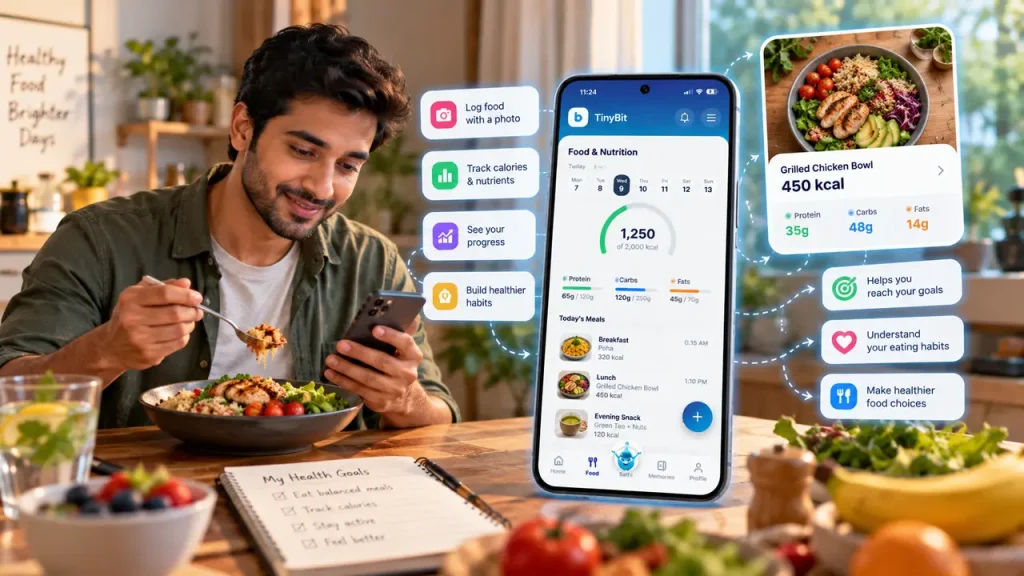
At TinyBit, the Calorie Calculator works as a food calorie counter that starts with a photo. You snap or upload a picture of your meal. TinyBit reads it and shows the calories, fats, protein and other nutritional value within seconds. AI does the reading, so you skip the search box and the scroll through food lists.
The useful part comes after the first week. Your meals build up into a record, so you can see what you ate across days and not just at one meal. Food insights point out patterns. Healthier meal suggestions offer ideas when a day looks lopsided.
Like any photo-based tool, TinyBit gives estimates. Use your own judgment when a meal looks unusual, such as a rich curry that seems to be counted light. TinyBit also has a daily check-in, so if you want, you can note your mood or sleep next to your meals and see how they line up.
Making calorie tracking a habit that lasts
Start small. Log only lunch in week one. Add dinner in week two. Snacks can wait.
Track ordinary days, too. Many people log the salad and skip the samosa, and the log becomes a portrait of their best self. A log full of real days is more useful, even when it looks messy.
Do not chase exact numbers. Whether a roti counts as 90 or 110 calories rarely changes the picture of your day. Chasing that gap only makes logging feel heavy.
Review patterns, not single meals. Take five minutes on Sunday evening and ask which day looked different, and why. One big dinner means nothing. Four in a row means something.
Use the app as support, not as a judge. It tells you what happened. You decide what to do about it.
One more thing, and it matters. Counting is not for everyone. If logging makes you anxious, pushes you to skip meals, or stirs up old habits around food, stop and talk to a doctor or dietitian. Anyone with diabetes, kidney problems or pregnancy should set targets with a professional, not with an app.
What most people ask
Q: Which calorie counter app is best?
A: The right choice is the app you will use daily. Look for quick logging, good coverage of the foods you eat, clear nutrient details, simple progress views and strong privacy. Try one for two weeks. If you still open it without dreading it, keep it. TinyBit‘s Calorie Calculator, which starts from a meal photo, is one option to test.
Q: How does a calorie counter app work?
A: You log what you eat by search, barcode, voice or photo. The app matches each item to a food database, estimates the portion, and adds up calories and nutrients for the day. Most then show weekly charts so you can spot patterns. The numbers are estimates, and they depend on how well the portion is described.
Q: Can a calorie counter app track food from a photo?
A: Yes, many can. The app studies the picture, names the food, estimates the portion and shows calories and nutrients. It works best on simple, well-lit plates. Mixed dishes with hidden oil or sauce are harder, so check the result and adjust it when something looks off. Photo logging is fast, which helps you keep the habit.
Q: What is a food calorie counter?
A: A food calorie counter is a tool that tells you how many calories a food or meal contains and adds them up across your day. It can be an app, a website or a printed chart. Apps are popular because they store your meals and show trends, so you do not have to do the math yourself.
Q: Are calorie counter apps accurate?
A: They are close enough to show patterns, but they are not exact. Errors come from database entries, portion sizes and hidden ingredients such as oil, ghee or sugar. Home-cooked meals are harder to count than packaged food. Use the totals as a guide, not a strict limit, and check unusual entries by hand.
Q: What features should a calorie tracking app have?
A: Look for fast logging, a food database that includes your usual dishes, calorie and nutrient details, quick re-logging of repeat meals, weekly progress views and useful insights. Privacy controls matter too, since food logs reveal habits and health goals. Photo logging is a bonus, not a must. Skip apps that push extreme targets.
Give it two weeks
Pick one app and use it for two weeks. Log ordinary days, samosa included. At the end, ask one question: did I still open it on day fourteen?
If yes, you have found the best calorie counter app for you, whatever the store ratings say. If no, change the app and keep your goals.
If you want to try a photo-first option, TinyBit‘s Calorie Calculator is one place to start. Take a picture of tonight’s dinner and see what the numbers look like.
You do not need perfect data about your food, only a steady habit of looking at it.


