
Introduction
An elderly AI companion is a conversational tool, usually voice or text based, that offers everyday interaction, reminders, and emotional check-ins for older adults. It can hold a conversation at any hour, track mood over time, and nudge a daily routine along, but it works best alongside family contact and professional care, not in place of either.
A house gets quiet in a specific way once the kids are grown and a spouse has passed or moved into care. Not loud-quiet, the ordinary kind, where the television is on mostly for the sound of another voice in the room. That particular quiet is what’s driving a real shift in who’s adopting AI right now. It isn’t twenty-somethings testing chatbots for fun.
AI use among adults 50 and older nearly doubled in a single year, from 18 percent in 2024 to 30 percent in 2025, according to AARP.
Something about being available at 3 a.m., with no schedule to check and no favor being asked, is landing with an age group nobody expected to be an early adopter.
What Is an AI Companion for Seniors?
An AI wellness companion for seniors is software, most often accessed by voice or text through a phone or tablet, built to hold a conversation, remember context from one chat to the next, and offer practical nudges throughout the day. It isn’t a chatbot in the customer-service sense, answering a fixed set of questions and stopping. It’s closer to an ongoing presence: something a person can talk to about their morning, ask to remind them about a doctor’s visit, or simply check in with when nobody else is around to check in.
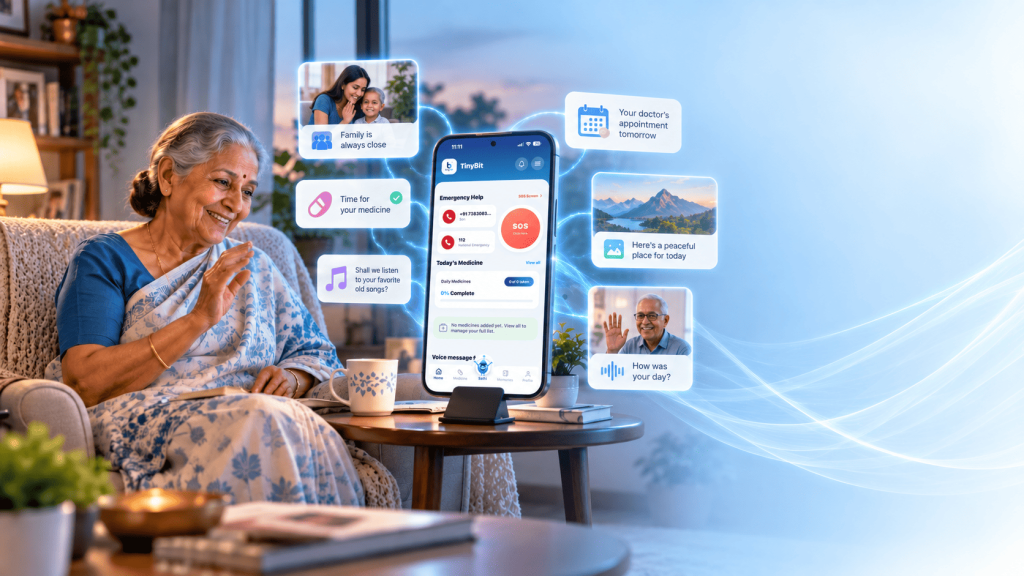
The better versions do three things at once. They converse, in a way that feels responsive rather than scripted. They remember, so a mention of a grandson’s visit last week isn’t lost by the next conversation. And they assist, folding in reminders, mood tracking, or light activities without needing to be asked twice.
Why Are AI Companions Becoming Popular With Seniors?
Adoption isn’t happening in a vacuum. It’s happening against a backdrop most families underestimate. About 28 percent of US adults 65 and older, roughly 13.8 million people, live alone, according to Census Bureau data. Social isolation is linked to a roughly 50 percent higher risk of dementia, per the CDC, and the US Surgeon General’s 2023 advisory put the mortality risk from chronic loneliness on par with smoking about 15 cigarettes a day. These aren’t soft statistics. Loneliness in later life carries a measurable physical cost.
At the same time, the access barrier that used to block older adults from digital tools has largely closed. Roughly 78 percent of Americans 65 and older now own a smartphone, per Pew Research. The technology isn’t the obstacle anymore. What changed is that something finally showed up worth using it for: conversation on demand, with no one needing to carve out time for it.
What Can an AI Companion Do for Seniors?
Set expectations honestly, because the useful version of this technology has a specific, bounded job.
- Hold a conversation. Talk about the day, a memory, a worry, without needing to explain context every time, the way a new person would require.
- Deliver reminders that land as conversation, not alarms. A medication or appointment reminder folded into a check-in feels different from a notification buzzing on a screen.
- Run daily check-ins. Mood, sleep, general wellbeing, logged in under a minute through talking rather than typing or tapping through forms.
- Offer light activity and engagement. Brain games, journaling prompts, or simple exercises that give structure to hours that might otherwise pass without much shape.
- Personalize over time. A companion that’s been used for months should sound less generic than one used for a day, picking up on routines, preferences, and recurring topics.
- Surface information on request. Weather, news, simple lookups, the kind of small daily questions that used to mean calling someone.
None of this requires the companion to be clever in a dramatic sense. It requires it to be present, consistent, and easy enough to use without a grandchild walking a parent through the login screen.
Can an AI Companion Help Seniors Stay Connected?
Partly, and it’s worth being precise about which part. An elderly AI companion can reduce the dead time between real human contact, the stretch between a daughter’s evening call and a neighbor’s weekend visit, when a house would otherwise sit silent. It gives a senior something to say good morning to.
What it can’t do is replace an actual relationship, and no honest description of this technology should imply otherwise. A conversation with an AI companion doesn’t carry the weight of a phone call from a child, the specific comfort of a familiar voice, or the accountability of someone who will actually notice if a visit gets missed. Used well, an AI wellness companion for seniors fills gaps between human connection. Used as a substitute for arranging that connection in the first place, it becomes a way for a family to feel less guilty about calling less.
How Can an AI Companion Support Independent Living?
Independent living depends on a lot of small, repeated actions going right: taking medication on schedule, eating regularly, staying engaged enough that cognitive and physical decline don’t accelerate quietly in the background. An AI emotional companion supports this by turning those small actions into a conversation instead of a chore.
A reminder that arrives as “did you get a chance to take your morning medication yet?” lands differently than a push notification a senior might dismiss without reading. A companion that asks how sleep went last night, and logs the answer, builds a pattern a family can actually look back on. None of this replaces a home health aide or a doctor’s visit. It fills the hours between them, where most of independent living actually happens.
Can AI Companions Support Emotional Wellbeing?
Within limits, yes, and the limits matter more than the yes. Conversational AI can offer a space to talk through a low mood, log emotional patterns over time, and respond with something other than silence at a moment when nobody else is awake. For a lot of seniors, that alone has real value.
What it cannot do, and should never be marketed as doing, is diagnose or treat a mental health condition. An elderly AI companion isn’t a therapist, and a pattern of low mood logged through the app should be a signal for a family member or a doctor to step in, not something the app itself resolves. The honest role here is early noticing, not clinical care.
What Are the Risks and Limitations of AI Companions for Seniors?
Worth naming plainly, because a fair picture of this technology includes its edges, not just its upside.
- Privacy. Conversations, mood logs, and daily patterns are sensitive data. Know what’s stored, for how long, and who can access it.
- Inaccurate information. Conversational AI can get facts wrong. It shouldn’t be a senior’s only source for medical or financial guidance.
- Over-reliance. A companion that fills conversational gaps well enough can, in some cases, mask cognitive decline family members would otherwise notice during a real call.
- Emotional attachment. Some seniors form a strong bond with a companion. That’s not inherently harmful, but families should stay aware of how much emotional weight is being placed on it.
- Accessibility. Voice recognition and interfaces that don’t account for hearing loss, tremors, or unfamiliarity with technology will go unused regardless of how capable the AI is underneath.
- Human oversight. The app is not a substitute for a family member or caregiver checking in. It’s a supplement, and it should be chosen and monitored as one.
How to Choose an AI Companion for an Older Parent?
A practical checklist before settling on one:
- Ease of use. Can it be operated by voice, with minimal menus and no complicated setup after the first day?
- Accessibility. Large text where relevant, clear audio, and forgiving input for anyone with limited dexterity or hearing.
- Privacy. Clear, plain-language answers about what’s recorded and who can see it, not buried in a lengthy terms page.
- Personalization. Does it actually adapt over time, or does every conversation start from zero?
- Safety. Is there a path from the companion to a real person or emergency contact if something concerning comes up in conversation?
- Voice interaction. For most seniors, voice-first design matters more than any other single feature.
- Family connectivity. Can mood trends or check-in patterns be shared with family, with the senior’s knowledge and consent, so a concerning pattern doesn’t go unnoticed?
- Transparency. Is it honest about what it is, an AI, not a person, and clear about what it can and cannot do?
The Presence, Purpose, Passage test is a fast way to sum this up. Presence: is it actually available when the person needs it, not just during a demo. Purpose: does it do something beyond talk, reminders, routine, mood tracking. Passage: does it point back toward human connection, prompting a call to family, rather than quietly replacing the reason to make one. An AI wellness companion that fails any one of those three isn’t wrong to use. It’s just not doing the full job.


